Kindergarten and Elementary
MD 1-1 Biochemistry E-Portfolio
ElynnJoshua Ali G.Nicdao
From laboratory precision to the deeper molecular language of medicine.
Enter the record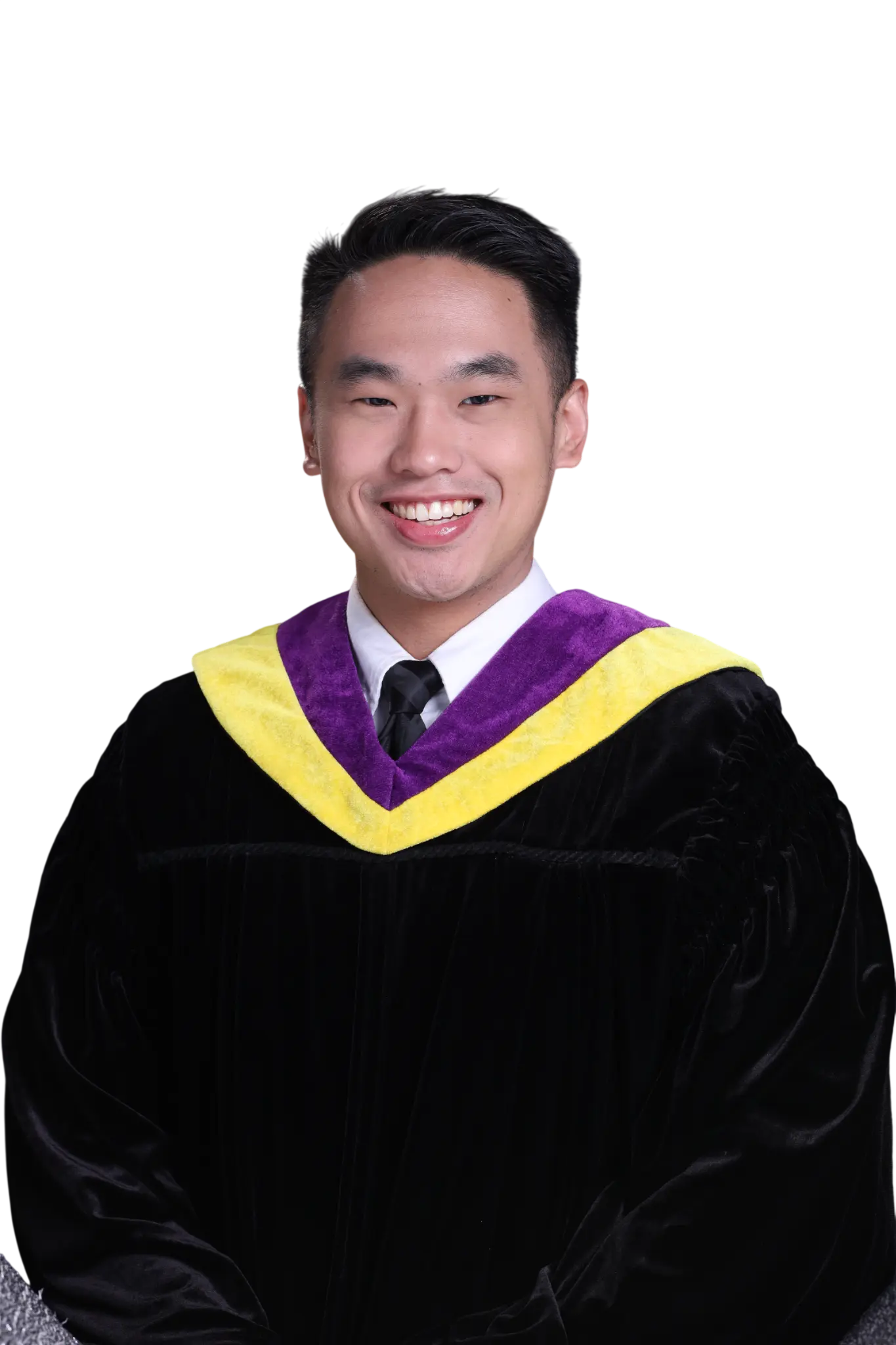
01
Identity file
Who I am
Many interests.
One direction.
Hi, I’m Elynn Joshua Ali G. Nicdao, but most of my family and friends call me EJ.
I’m the eldest of three siblings, and I’m from San Fernando City, Pampanga. I grew up in a family where medicine and business have always been a big part of our lives. My father is a physician, while my mother is a businesswoman.
I wouldn’t say I was the smartest or most talented growing up. If anything, I’d describe myself as a “jack of all trades, master of none.” I’ve always been interested in different things and enjoyed trying and learning something new rather than sticking to just one.
Basketball, going to the gym, running, and cars have been interests of mine for years, and they are still a big part of my life today.
“Becoming a physician has always been a dream of mine. I want to earn the title while becoming someone who can genuinely make a difference in other people’s lives.”
Academic trajectory
Built through
every stage.
My educational journey has taken me through different schools and experiences that helped shape who I am today.
Junior High School
Don Bosco Academy of Pampanga
Grades 7 to 10Senior High School
University of Santo Tomas
Health Allied StrandUndergraduate
University of Santo Tomas
BS Medical TechnologyPresent
MCU College of Medicine
Doctor of Medicine, Year 1
Foundation
Completing my Bachelor of Science in Medical Technology gave me a strong foundation in the medical field and further strengthened my interest in pursuing medicine. I am now continuing that journey as a first-year medical student.
Clinical experience / April to June 2026
Accuracy is
part of care.
Working in a small clinical laboratory gave me firsthand experience with the responsibility behind every specimen.
I collected blood specimens, made sure samples were correctly handled and labeled, and helped prepare and organize them before processing. Patient identification, the correct collection tube, infection control, and an orderly work area all mattered because even a small error could affect a laboratory result.
The role improved my confidence and technical skills in venipuncture. It also taught me that healthcare requires more than technique: patience, clear communication, compassion, attention to detail, and professionalism are equally important.
That experience gave me a deeper appreciation of how laboratory work contributes to diagnosis and management, making it even more meaningful as I continue toward becoming a physician.
VenipunctureSpecimen handlingPatient communicationInfection controlAdaptability
01FoundationWater, pH, and My First Impressions
+
Water, pH, and My First Impressions
My first few Biochemistry discussions made me realize that I was entering a subject that would require a different kind of studying. I had already encountered laboratory concepts during my undergraduate years, but studying Biochemistry as a medical student required me to see what happens inside the human body.
Water and pH showed me that I could not rely on memorization alone. Equations and concepts had to be understood before they could be applied. Eventually, I saw why these ideas appear so early in Medicine: water influences countless processes, while even a small shift in pH can disrupt normal physiological function. Dehydration, vomiting, and diarrhea made fluid and acid-base balance feel clinically real.
My Medical Technology background also changed how I viewed the lesson. Instead of seeing a laboratory value as an isolated number, I began looking for the biochemical explanation behind it. The Kahoot activity made the class less intimidating and helped me see that difficult subjects can still be engaging.
02AssessmentQuiz 1 and Quiz 2
+
Quiz 1 and Quiz 2
The first two quizzes were an early reality check. I was still learning how to approach Biochemistry questions, especially those that required more than remembering lecture material. Both were challenging, but I earned passing scores while still adjusting to the subject and the pace of medical school.
I also realized that repeatedly reading my notes was not enough. I needed active recall and self-testing instead of simply recognizing the material on a page. The quizzes were not perfect performances, but they showed me where I stood and what I needed to strengthen for the next assessments.
03SGD 01The Mystery Behind Waters
+
The Mystery Behind Waters
Our first SGD helped me appreciate the difference between knowing a concept and using it in a patient situation. Vomiting and diarrhea may sound like common complaints, but prolonged fluid loss can affect hydration, electrolytes, and acid-base balance. The body’s systems do not work independently; when one is disturbed, another may respond to compensate.
The case changed the way I look at symptoms. I need to ask what else could be happening beneath the obvious complaint. It also proved that Biochemistry is not just a collection of reactions; it can explain why patients develop particular signs and symptoms. I almost forgot to submit the activity amid the class suspensions, and I remain grateful that Doc Alvin allowed me to pass my output.
04July 31, 2026Communication Skills
+
Communication Skills
Our doctor-patient role-play reminded me that future physicians must communicate with people who may be nervous, uncomfortable, or unfamiliar with medical terminology. Open-ended questions allow patients to explain concerns we might not think to ask about directly.
I also learned that communication affects the quality of information we receive. A patient who feels rushed may leave out something important, while someone who feels genuinely heard may share more. Becoming a physician is not only about the correct diagnosis or treatment. Communication connects medical knowledge to the person in front of us.
05SGD 02When Iron Is Not Enough
+
When Iron Is Not Enough
This self-directed activity felt personal because anemia was familiar from my Medical Technology experience. I knew the CBC parameters, but recognizing hemoglobin, hematocrit, MCV, and MCH is different from understanding the biochemical events that create those findings.
I realized that I had sometimes viewed low hemoglobin too simply. Iron deficiency matters, but it is not the only explanation. Several findings must be considered together. My laboratory background helped me recognize the values, while Biochemistry helped me understand what was happening behind them. I am not starting from zero; I am taking what I know and learning it at a deeper level.
06Human side of medicineCommunication in Medicine
+
Communication in Medicine
Creating our summative communication video made me conscious of how easily a patient conversation can become focused only on obtaining answers. Patients will not always describe a problem in the exact way we expect. Open-ended questions give them room to speak in their own words and may reveal concerns that would otherwise remain unspoken.
I learned that listening is an active skill. It is not enough to hear the words; I have to notice the meaning behind them. Good communication shapes the entire encounter because before I can properly help someone, I first need to understand what they are experiencing.
07Virtual laboratoryIntroduction to Labster
+
Introduction to Labster
Labster was not completely new because I had encountered virtual laboratory work during first-year chemistry at UST. This time, however, I viewed it as a medical student with experience from an actual laboratory.
Real laboratory work taught me that accuracy, technique, and understanding the purpose behind a procedure all matter. Virtual simulation offers something different: it can make molecular processes visible when they cannot be directly observed during routine testing. I became interested in how it could complement the practical knowledge I had already gained.
08Protein foundationAmino Acids, Peptides, and Primary Structure
+
Amino Acids, Peptides, and Primary Structure
The number of amino acids, structures, and characteristics quickly showed me that memorization alone would not make the topic easier. Determining primary protein structure required careful analysis instead of simply recalling definitions.
With repeated review, the bigger picture became clearer. Amino acids matter because their arrangement influences what a protein can do, and altered protein structure or function can have significant effects on the body. This topic taught me that I cannot expect mastery after one reading. Some ideas require repeated practice, and I have to give myself that time.
09August 14, 2026Quiz 3 and Quiz 4
+
Quiz 3 and Quiz 4
The third and fourth quizzes were the most difficult assessments I had encountered so far. There were parts of protein structure that I thought I understood until I had to apply them to a question. I was unable to pass one quiz, which was disappointing because I had studied well the night before and expected a better outcome.
The result taught me to study the textbook more carefully rather than scanning it. These quizzes became more than memory tests; they revealed which parts of my understanding were still weak and gave me a clear reason to change how I prepared.
10August 23, 2026The 2:30 AM Review Class
+
The 2:30 AM Review Class
The review class with Doc Alvin is something I will probably remember beyond this semester. We continued until almost 2:30 AM. I was already tired, but I stayed until the end and felt a sense of accomplishment for pushing through.
More importantly, I appreciated Doc Alvin’s effort to make sure we were prepared. That night reminded me that medical school is not something I have to face through individual effort alone. Professors guide us, and classmates share many of the same struggles.
11August 27, 2026Hemoglobin and Myoglobin
+
Hemoglobin and Myoglobin
Hemoglobin felt familiar from my Medical Technology background, but the discussion showed me how much more there was to understand. I learned how its structure supports oxygen binding and how factors such as pH can change oxygen affinity. Hemoglobin is not simply a fixed carrier that picks up oxygen and drops it elsewhere.
Myoglobin offered another perspective through its role in muscle. What interested me most was discovering the larger biochemical story behind a familiar laboratory value. Medicine allows me to revisit what I already know and understand it at a completely different level.
12September 3, 2026Prelim Examination Review
+
Prelim Examination Review
After our Histology prelims, our online Biochemistry review ran from around 5:00 PM to 11:00 PM. I was tired, but I knew the session mattered. Doc A continued guiding us even though it was already late, and afterward I stayed up studying with friends.
That experience taught me that medical school is not always about being the smartest person in the room. Sometimes it is about continuing when I am tired, accepting help, and having people beside me who understand the same pressure.
05
Beyond medicine
What keeps me
in motion.
Medicine is my direction, but movement, machines, family, and new places remain part of how I recharge and keep learning.
06 / Final record
What Biochemistry has taught me so far
Difficulty does not always mean
I am failing.
When I look back at the past several weeks, my biggest takeaway is not one pathway, equation, or protein. It is the realization that I am still learning how to become a medical student.
My Medical Technology background gave me familiarity, but Biochemistry showed me the limits of what I knew. Recognizing hemoglobin in a CBC is different from understanding its structure and oxygen-binding behavior. Knowing that a patient is anemic is different from understanding why.
I have learned that medical school leaves little room for simply reading notes again and again. I need active recall, practice, honest identification of weak areas, and the patience to revisit what I did not understand the first time.
I do not have to feel confident all the time. I can be confused and continue. I can answer incorrectly and study again. I can feel disappointed without letting that disappointment decide whether I keep going.
Difficulty can simply mean that I am learning something new. My goal is not to make every subject easy, but to become better at facing what is difficult—to understand instead of only memorizing and to remember why the science matters when I eventually meet it in a patient.
For now, I am learning one topic, one quiz, one review session, and one difficult day at a time. Maybe that is what progress looks like at this stage of my journey.
The direction ahead
Knowledgeable.
Competent.
Compassionate.
This portfolio is more than a collection of education and experiences. My work as a phlebotomist and participation in medical missions taught me that healthcare is not only about knowledge and skill, but also compassion and understanding. I want to develop the discipline, confidence, patience, and character needed to become a physician people can trust—someone who makes patients feel heard, cared for, and respected.
“I may not have everything figured out yet, but I know the direction I want to take.”